Mobile Robots: Advanced simulation for AGV and AMR
Efficient planning and control for modern mobile robot systems

Simulating complex, driverless transport systems made easy

Why conventional methods are not enough
Automated, driverless transport systems offer enormous potential for intralogistics. However, their increasing complexity makes precise planning and simulation challenging – static methods such as Excel quickly reach their limits.

Visual Components as a powerful basis
The Visual Components simulation platform provides powerful features for fast, clear simulation. To map dynamic factors and complex fleets even more realistically, we have developed the Mobile Robots Library.

More possibilities with DUALIS Mobile Robots
Our library extends Visual Components with features such as battery management, traffic rules, fleet optimization, and reporting – for efficient planning, analysis, and optimization of your AGV/AMR fleets.
Holistic approach: From planning to virtual commissioning
The Mobile Robots Library covers the entire process:
- Planning your AGV/AMR fleet and layout
- Simulation of dynamic factors such as traffic rules, battery management, and incidents
- Analysis of KPIs and scenarios for informed decisions
- Virtual commissioning to validate the control logic before real-world deployment
- Permanent optimization through what-if scenarios and continuous adaptation
This allows you to avoid duplicate implementations, shorten implementation time, and secure your investments – with a solution that intelligently combines fleet management and factory simulation.
AGV route planning and visualization made easy
Your features for simulating mobile robots (AGV, AMR)
Advanced control and configuration pptions for AGVs
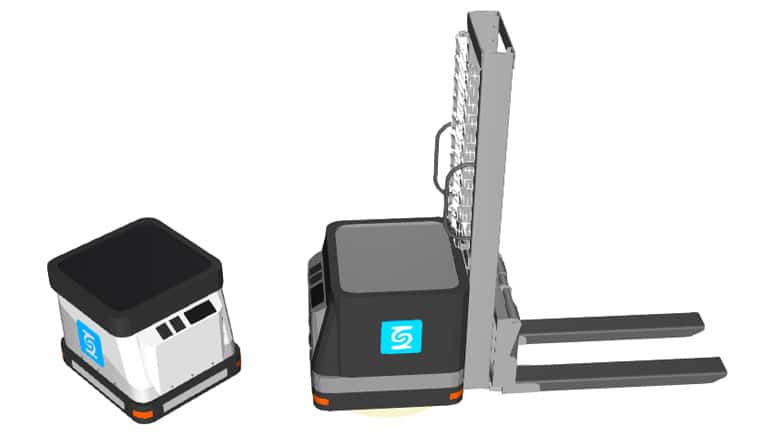
The DUALIS Mobile Robots Library opens up completely new possibilities for controlling and configuring your AGV fleet. Prioritize transport orders, define individual workflows, and combine a wide variety of vehicle types in a single layout – all with just a few clicks. The fully parameterizable, manufacturer-independent vehicle geometry and support for complex motion sequences, such as those required for forklift AGVs or Cartesian models, ensure maximum flexibility and realism. This allows you to get the most out of your intralogistics.
Route definition as a network and movement of AGVs in the network
With the DUALIS Mobile Robots Library, you can transform the route definition of your AGVs into a powerful, visual network of nodes and connections. Each node can be flexibly used as a process, loading, or waiting point – external components can be seamlessly integrated. The capacity-based network structure guarantees collision-free and optimally controlled material flow. Thanks to intelligent algorithms in the fleet manager, you benefit from automatic route optimization and an efficient solution for vehicle encounters – for maximum transparency and safety in your intralogistics.
Fixed work sequence and situation-dependent behavior
With the innovative mission manager of the DUALIS Mobile Robots Library, you can control orders and their sequence more flexibly than ever before. Define fixed processes, such as for route trains, and dynamically adapt the behavior of your vehicles to each situation – without any complex programming. Control structures and variables enable intelligent, demand-driven control of your fleet. This allows you to simulate even challenging scenarios easily and clearly, taking your intralogistics to a new level.

Additional features that take your AGV planning and simulation to a new level
Vehicle models & customization
Simulate five flexibly configurable vehicle types, including forward/reverse driving, swiveling axles, and customer-specific geometries. Manufacturer-specific models are also available on request.
Battery management & charging during the process
Each vehicle has realistic battery management. Vehicles charge automatically when the battery level is low and can be charged inductively during the process time – for maximum availability.
Error management & failure simulation
Plan cyclical vehicle failures and analyze the impact on material flow. This allows you to identify critical bottlenecks and increase the resilience of your fleet.
Obstacle detection & collision checking
Geometry-based scan fields detect obstacles and ensure safe traffic control. Before each driving maneuver, the library checks whether the next network node is free.
Traffic rules & routing
In addition to capacity ranges, traffic lights, no-turn restrictions, dead ends, and route limitations are supported. Routing is carried out via a guided network with optional evasive maneuvers.
Detour strategies & dynamic fleet control
Vehicles intelligently adjust their route to avoid obstacles, broken-down vehicles, or idle vehicles. This keeps the flow of materials efficient even in the event of disruptions.
Import/export of route networks
Export and import route networks in JSON format – for reusable scenarios and external analyses.
Fleet management & multi-objective optimization
A central controller manages the entire fleet. Tasks are optimized and dynamically assigned according to priority, distance, travel time, power consumption, or mixed criteria.
Cooperative transport (swarm bots)
Simulate transport tasks that require multiple vehicles simultaneously – for planning modern intralogistics.
Advanced statistics & reporting
Record fleet KPIs such as assignment duration, running distances, charging cycles, and energy consumption. Visualize heat maps and analyze delays.
AGV/AMR evaluation made easy
The DUALIS AGV Library can be combined with the DUALIS statistics module. With just one click, you can generate a detailed Excel report that lists all the important key figures for the AGV/AMR simulation and presents them in a visually appealing way. A scenario comparison is also possible. This allows you to quickly identify where there is potential for optimization or which variant works best and gives you the greatest output. In the future, this will be even easier with an automated scenario manager.
Special functions & components
Simulate complex systems with extended buffer functions, hall doors (including waiting times), elevators, turntables, and horizontal shuttles.
Key Mobile Robots features at a glance
Experience the DUALIS Mobile Robots Library live and request your personal demo or talk to our experts about your project.
Why you should choose DUALIS Mobile Robots
With the DUALIS Mobile Robots Library, you can lay the foundation for modern, efficient, and future-proof intralogistics. Discover the most important advantages at a glance:
Visualization and traceability:
The network approach makes the AGVs’ routes and decision-making processes transparent. Routes and process progress are clearly visualized – for maximum overview and control.
Scenario management and what-if analyses:
Easily simulate different variants and “what-if” scenarios. Quickly evaluate and compare alternative supply concepts, fleet strategies, or process changes.
Planning reliability and optimal design:
Minimize risks and secure your investments through realistic simulation and demand-oriented dimensioning of your supply concepts.
Flexibility and adaptability:
Configure vehicle models, movement sequences, and traffic rules individually for realistic representation of diverse scenarios.
Integration and expandability:
Easily integrate the library into Visual Components, combine it with other DUALIS add-ons, and connect to external systems such as MES or fleet managers if required.
Detailed reports and evaluations:
Comprehensive analysis functions provide all relevant key figures on the fleet and processes – enabling informed decisions and targeted optimization.
Best Practice: Precise planning of AGVs ensures investment security at Fabmatics
Mobile Robots Library successfully deployed since 2022

Martin Däumler
Department Manager Product Development & Product Support, Fabmatics GmbH
Special application case: AGV simulation – double swap
An AGV brings a load to a station, deposits it there, and picks up a new load at the same location – twice in a row. This eliminates the need for two separate AGVs for the respective task, as a single AGV can perform both tasks efficiently.
FAQs on planning and simulating AGVs and AMRs with the Mobile Robots Library for Visual Components
What is the difference between AGVs, AMRs, and mobile robots?
Mobile robots is the umbrella term for all automated, driverless transport solutions that move materials or goods within a facility. This includes both AGVs (Automated Guided Vehicles) and AMRs (Autonomous Mobile Robots).
AGVs follow fixed routes, usually defined by floor markings or virtual guidelines. They are particularly suitable for structured environments with clearly defined routes.
AMRs are more flexible: they navigate freely in space, detect obstacles, and dynamically adjust their route. This makes them ideal for complex or changing layouts.
AGV (Automated Guided Vehicle) is the generic term for all systems that use driverless transport vehicles – i.e., both AGVs and AMRs.
The Mobile Robots Library supports both technologies and enables realistic simulation of simple and complex fleets.
What license do I need for AGV/AMR simulation?
To use the Mobile Robots Library, you need at least Visual Components Essentials and the Mobile Robots add-on.
Visual Components Professional is required to import your own CAD geometries.
How quickly can I start with AGV/AMR simulation?
If you already have experience with Visual Components, getting started with the Mobile Robots Library is easy. If necessary, we offer an introduction in the form of training.
If you do not yet have any expertise, we recommend providing an internal resource for training. Our experience shows that this significantly speeds up the start of the project.
What distinguishes the Mobile Robots Library from the standard functions in Visual Components?
Visual Components uses pathways for freely moving AGVs as standard. The Mobile Robots Library relies on a network approach that offers more control over vehicle movement and guarantees collision-free operations.
How do we get our own AGVs or AMRs into the library?
A simple geometry exchange (CAD import and parameterization) can be carried out by the customer themselves. We can integrate special vehicle types as a service on request. Visual Components Professional is required for CAD import.
Can existing layouts and projects be reused for AGV/AMR simulation?
Yes, existing projects from Visual Components can be easily expanded and supplemented with the Mobile Robots Library.
Which process components and special functions for AGVs/AMRs are supported?
The library is fully compatible with the Visual Components standard. In addition, elevators, hall doors, turntables, shuttles, and complex buffer functions can be simulated, for example.
Is it possible to connect to external systems such as MES or fleet managers?
Yes, connection to external systems is possible on request – e.g., via add-ons such as TCP Connect or interfaces such as VDA5050 for communication between real fleet managers and virtual vehicles.
What evaluations and KPIs are available for AGV/AMR simulation?
In addition to the standard statistics from Visual Components, we recommend the separate statistics add-on, which can be ideally combined with the Mobile Robots Library. This provides you with detailed evaluations of utilization, travel distances, energy consumption, and process times – with just one click.
For which industries and use cases is AGV/AMR simulation suitable?
The Mobile Robots Library can be used across industries – from automotive supply to electronics manufacturing to logistics.
Is there training or support available for the Mobile Robots Library?
Yes, DUALIS offers training and technical support for a quick project start and smooth implementation. Training courses can be booked at any time.
What options are available for influencing the driving behavior of AGVs/AMRs?
The network approach allows numerous restrictions for individual connections, e.g., speed and access restrictions depending on the goods being transported. In addition, vehicle groups can be assigned to specific areas. Traffic rules such as traffic light control, capacity ranges, turning restrictions, and dead ends can also be configured.
What options are available for influencing task management for AGVs/AMRs?
The library uses proven algorithms from the literature. Numerous setting parameters allow you to individually control the behavior of the AGVs/AMRs – from priorities and cost optimization to multi-objective strategies.
